
Archive

Archive for October, 2009

Information vs. Confusion

October 25th, 2009 Comments off

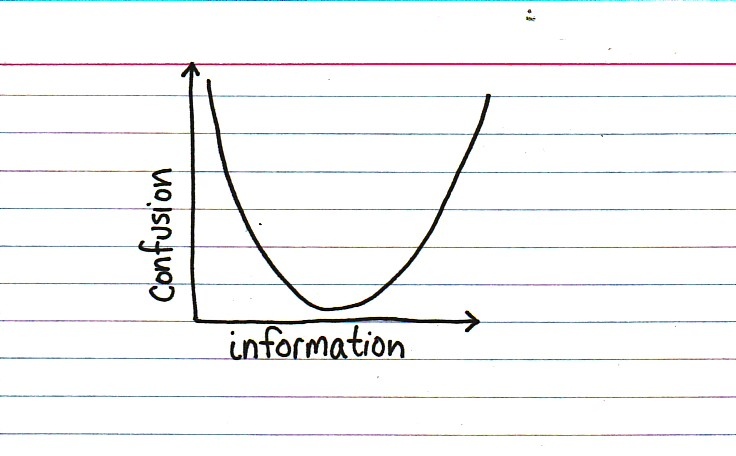
I just returned from the Microsoft Sharepoint Conference in Las Vegas. So much information on collaborative technologies! However, out of all of the sessions I attended, one image stuck out from the rest.

We all know this intuitively, but it’s easy to fall into the trap when researching a new direction, or in the analysis phase of a project:

CvsI

Categories: Basics

The Pen is Mightier than the Computer

October 21st, 2009 1 comment

moleskinI still get people doing a double-take when they see my PDA. It’s light-weight, portable, never needs recharging and is instant-on. Yup, I use a Moleskine notebook and a pen. It’s always on me, I’m always jotting notes in it and it has (so far) never failed me.

David Hornik recently wrote a post on how he’s seeing more and more Senior Executives using real, old-fashioned notebooks and pens in meetings. Fewer and fewer are bringing out their laptops.

I concur. And I also find that people that are using laptops are often not listening to the meeting, nor are they taking notes relevant to the meeting. They’re using it to catch up on other work or responding to email. I’m guilty of that as well with my Blackberry. If I have it on the table during a meeting, I find myself constantly checking it and responding when I should be listening.

Once or twice (OK, more), I’ve been caught flat-footed when a question was asked of me. I have that blank stare, try to think of something, and often resort to asking the person to repeat the question.

So now, I’m a pen and paper person as well. My note book never fails me. Why:

  1. Instant on. Don’t have to wait for a boot up. Don’t have to find a power outlet. Don’t have to log in.
  2. Always connected. I don’t have to look for a signal. All of my info is right there.
  3. Rugged. I have a tendency to drop my toys. Not an issue with my notebook.
  4. Memory. I’m talking about mine. I find that if I write something down with pen and paper, I remember it. I almost never have to refer to my notes again. The very act of writing it down works well enough. I can’t say the same about typing a note.

So please don’t laugh at my when I bring out my notebook. I’m only following the example set by the movers and shakers!

Categories: Basics

What are your goals?

October 18th, 2009 Comments off

whuffWhen I wrote about the Basic Pillars of a Digital Strategy, the question I received most often was ‘What goals can I start with?’ It’s difficult to answer as the goals are usually internal to the needs of your company and your brand. I outlined in my post about measuring your ROI about how you can turn qualitative goals into quantifiable measurements. But there are some qualitative goals you may want to keep in mind that you may not want or need to measure. They are goals that should be part of your strategy, but only if you truly believe in Social Media as a way to keep in touch with your customers:

  1. Listening
    Before doing anything, listen to what’s going on. Use any sort of paid or free monitoring tools to find out what is being said about your company and your brand. These are your customers, your potential customers, your peers and competitors, your evangelists and detractors. Use their unsolicited feedback to help shape your strategy and improve your business.
  2. Caring
    Listening won’t do much if you don’t care about the response… and show that your care about the response. Before telling your own stories and pushing your products, respond back to those who took the time to comment about you. Give thanks for positive feedback and help turn your detractors into evangelists.
  3. Sharing
    Those who care about your company, your brand and your products love to get the inside scoop on what’s going on. Share stories of real people inside your organization, real trials and tribulations you’re facing, real success stories.
  4. Speaking
    Get involved in the conversations taking place all around the internet. Get engaged with your audience and talk where they are listening. The response received when a person from a company responds to a user on an open forum is usually positive, if it’s done with a human voice, with genuine caring and without spin.
  5. Building relationships
    Building strong relationships with influencers online is one of the most effective ways to keep building positive social currency, or ‘Whuffie‘ as it was coined by Cory Doctorow and used by Tara Hunt.

These goals are hard to measure, but they should be part of any Digital Strategy as they are the currency that enable your company to truly engage with your audience.

Categories: social-media, Strategy

Controlling the conversation

October 13th, 2009 1 comment

megaphone“… But what if people say something bad about us? On our own site? How would that look?”

This is probably the number 1 fear from executives about opening up the corporate or brand website to user-generated content. And they have a good point. What if you build it and they actually do come? To complain?

I’m here to say that not only is that a possibility, it’s probably going to be the reality. Probably not what the executive wants to hear. But the real questions shouldn’t be ‘What do we do if…’ but ‘What do we do when…’

Let’s get the obvious out of the way first. If you have a product or service that holds a promise that you don’t deliver, you have bigger problems than the comments on your website or public forums. You have a bad, unsustainable business model. But let’s assume that you have a good product or service and you strive to deliver value to the customer. You’re still going to have some people not happy and they may vent on your site. That’s not a bad thing.

“What?”

That’s right. It’s not a bad thing. As a matter of fact, this is a perfect opportunity to turn it to your advantage. Everyone knows that you can’t please all of the people all of the time. How you respond to those issues makes a big difference.

  1. Allow comments on your site and your postings:
    First things first. If you want to be true to the ‘social’ part of your social strategy, you have to let your customers be heard. Their comments are the voice you’ve been wanting to hear. Unfiltered by your staff. Again, if you are holding your end of the bargain, you will have good comments more often than the critical ones, but encourage both. Use the comments as an opportunity to get market research from the people that took the time to come to your site. But that doesn’t mean you have to let anything through.
  2. Have a visible and permissible moderation policy:
    You do have to moderate your comments. But your moderation policy has to be clearly posted and fair. Criticism must be allowed, and even encouraged. However, language must be civil. No spam, advertising, link bait, personal attacks or off-topic comments. Otherwise, even if the criticism seems unfair, it stays.
  3. Respond to your evangelists and critics alike
    Let people know that you’re listening. That doesn’t mean that you have to respond to every comment. But comments that are critical or evangelical deserve a nod of acknowledgment. As simple as “Thank you” or “Much appreciated” for good comments is enough.
  4. Respond with a human voice
    For the critics, you have a choice. For simple customer service issues, a comment from the company stating, ‘Please contact Joe directly at this email address and he’ll make sure your issue gets the attention it requires” is remarkable. Not only are you helping to resolve an issue for one of your customers, but you’re doing so in a public way, letting everyone else know that you do, in fact, care about your customers. In other words, do not have all responses to your customers come from your PR department. Do not regurgitate the marketing speaking points. If you do it correctly, you may turn customer complaints into kudos as @comcastbill has been able to do for Comcast.
  5. Allow SMEs through the company to respond on the company’s behalf
    SMEs stands for Subject Matter Experts. If there are questions or concerns about a specific product, let the people in charge of that area respond with a human touch. Answer questions clearly and directly. Again, not just with a marketing line, but as if you actually *do* care about what the respondent is saying.
  6. Spiral out. Respond on other sites, not just your own
    Use an alert tool, such as Google Alerts to monitor your name in the news. BlogPulse, or Radian6 to monitor what’s going on in the Social Media space. If you see mentions (good or bad), go to those sites and respond. Let the world know that you care about your customers, where ever they are talking.

Building loyalty and evangelists comes from not just having a good product or service, but making sure that your customers feel like they are being heard.

Categories: social-media, Strategy

How to Work Better

October 3rd, 2009 Comments off

workbetterI’ve had this image printed out and kept in the back of every notebook I’ve carried around for the last couple of years. It’s very simple advice, but if taken to heart, can literally change the way you go about your day-to-day. I think the image to the right of this post is the original photograph, but below is a much better rendition of the same content:

workbetter2

If you’re reading this on a small screen, here is the text:

  1. Do one thing at a time
  2. Know the problem
  3. Learn to listen
  4. Learn to ask questions
  5. Distinguish sense from nonsense
  6. Accept change as inevitable
  7. Admit mistakes
  8. Say it simple
  9. Be calm
  10. Smile

Allow me to highlight a few of these that changed the way I think when I’m working. The first one… ‘Do one thing at a time’ is a very important one. I don’t believe that human beings are capable of multi-tasking. There is a huge reduction in returns when you try to do more than one important thing at a time. I’ve tried. When I try to do two things, neither one is even 50% as good as if I had focused on it completely. Prioritize, concentrate on the most important item and either complete it, or leave it at a logical point where you can pick it up again.

(On a side note, I read a sage piece of advice once that works beautifully. If you’re going to leave something to pick up again later, leave it in mid-sentence. When you pick it up again, as you get into the flow of picking up that sentence, you’ll get back into the flow you were in when you left it… which is exactly how I left this article in draft for a couple of weeks.)

The next important one is ‘know the problem.’ I deal with it quite often. The first thing you think about is the problem. Usually, you’re wrong. There is an old saying that you have to ask ‘Why’ 3 or 4 times before you get to the heart of the problem, or the Root Cause. Until you know the problem, it will be difficult to work on the solution.

‘Learn to listen’ and ‘Learn to ask questions’ are related. Learning to listen means more than just keeping your mouth shut. It also means more than just sitting there silently waiting for your turn to speak. I relate it more to Stephen Covey’s line of “First seek to understand, then seek to be understood.” Your questions should clarify the other point, not subtly drive the person to your view point.

‘Say it simple’ relates directly to an article I posted earlier about being able to explain it to a 6-year-old.

… and again, if you’ve ever worked with me, you’ll know that when all hell is breaking loose, I’ll be sitting there with a calm smile (whether I feel it or not). I’m a big fan of the duck analogy. “Calm and serene on the surface, but paddling like hell underneath!”
Categories: Management