Archive

Posts Tagged ‘linkedin’

Speaking at the IFIC Leadership Forum

November 6th, 2012 Comments off

I was recently invited to speak at the Investment Funds Institute of Canada (IFIC) Leadership Conference. Prior to my talk, Investment Executive asked me to sit down and discuss social media in financial services. Below is the video that was posted to IE.TV.

Click on the images to go to the video

Silu Modi at the IFIC Leadership conference on IE.TV

Silu Modi speaking at the IFIC Leadership Conference

Categories: Press, social-media

Taking stock in social media

October 16th, 2012 Comments off

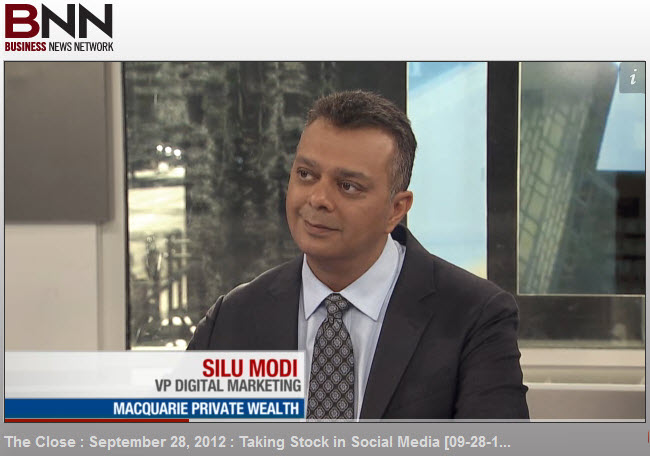
I was recently a guest along with Mike Newton on BNN’s “The Close” with Michael Hainsworth. We were interviewed for a 7 minute segment on social media in financial services. Though I was quite nervous (first time doing LIVE tv), Michael Hainsworth was a great host and put me at ease immediately. Happy to say that I didn’t embarrass myself. Actually, I’m quite happy with how it went. Now I have the media bug in me!

Click on the images below to watch the clip on BNN’s website

Silu Modi on BNN – Taking stock in social media


Silu Modi on BNN – Taking stock in social media

Categories: Press, Strategy

Getting the basics right

October 16th, 2012 Comments off

It’s easy to forget the second word when talking about Digital Marketing. The word ‘digital’ just describes the channel being used. It’s actually all about ‘marketing’. Without a thorough understanding of the basics of marketing, the next new shiny toy won’t help reap any rewards.

My clients often ask me what the next new technology or channel is for their digital marketing efforts. I can often sense the frustration when I tell them to first work on their website, write some compelling thought-leadership pieces and send excerpts out to their audience using an email campaign tool. Then measure, adjust, refocus, lather, rinse and repeat. Only when you’ve exhausted the basics should we consider adding a new channel to your marketing.

Learning the basics of marketing is easy. Executing the basics of marketing is hard. Not difficult, but it takes time, labour and consistent persistence. It takes some time (months, usually) to see measurable results from basic marketing. But once you have the basics right and firing on all cylinders, adding a new technology or channel into the mix is much easier.

As my old boss used to say… “Don’t worry about the tricks of the trade until you’ve actually learned the trade!”

It seems more and more of my blog posts have the obligatory Seth Godin reference. It didn’t take long to find a post from Seth that (again) summed this up better than I could:

Fledgling sushi chefs spend months (sometimes years) doing nothing but making the rice for the head chef.

If the rice isn’t right, it really doesn’t matter what else you do, you’re not going to be able to serve great sushi.

Most of the blogging and writing that goes on about marketing assumes that you already know how to make the rice. It assumes you understand copywriting and graphic design, that you’ve got experience in measuring direct response rates, that you’ve made hundreds of sales calls, have an innate empathy for what your customers want and think and that you know how to make a compelling case for what you believe.

Too often, we quickly jump ahead to the new thing, failing to get good enough at the important thing.


Categories: Basics, Strategy

In the news…

October 1st, 2012 Comments off

Over the last year or so, I’ve been fortunate enough to receive some press for the digital marketing my firm has been doing.

At the end of August this year, Investment Executive released their 2012 Advisor Scorecard. Within the scorecard was a story titled “Apprehension over social media” by Clare O’Hara talking about how some financial firms are still having difficulty understanding how to use social media effectively while staying within regulatory guidelines. I was quoted in the article:

Even before IIROC set its guidelines, Macquarie was one step ahead, having created a social media committee and an advisor pilot project in early 2011. “We never wanted to block social media,” says Silu Modi, Macquarie’s vice president, digital marketing, banking and financial services group. “We always wanted to figure out how we can use it.”

In July, I was quoted in the Wall St. Journal in an article about how advisors are using social media and what role a financial advisor should play on Twitter:

“Tweets and points should not be timely but timeless–we shouldn’t be the ones breaking the news,” said Silu Modi, vice president for digital marketing at Macquarie Group Ltd.’s (MQG.AU) North American operations.

And finally, in May 2012, I gave a talk at the Digital Marketing for Financial Services conference. Advisor.ca ran an article about my presentation titled “Regulation doesn’t stifle social media” taking excerpts from my talk:

He adds, “If you aren’t using these social media tools, you are throwing away a huge chunk of your potential market.”

Modi stresses, though, “Social media is not a digital or marketing strategy. It’s only one part of a complete strategy and you need to fold it in with your other efforts.”

In a future post, I’ll add more recent press our work has received.

Categories: Basics, Management, Press

Happiness and Success

September 24th, 2012 Comments off

Occasionally, I write a post that has nothing to do with digital strategy. This is one of those. I wish I knew where I found this list, but I can’t find the source. It ended up in my Evernote list of unfiled notes. I think it’s brilliant. I’ve tried to live by as many of these rules as I can (and knocked #1 out of the park!). I hope you find it as inspiring as I do


How to find Happiness and Success:

  1. Marry the right person. This one decision will determine 90% of your happiness or misery.
  2. Work at something you enjoy and that’s worthy of your time and talent.
  3. Give people more than they expect and do it cheerfully.
  4. Become the most positive and enthusiastic person you know.
  5. Be forgiving of yourself and others.
  6. Be generous.
  7. Have a grateful heart.
  8. Persistence, persistence, persistence.
  9. Discipline yourself to save money on even the most modest salary.
  10. Treat everyone you meet like you want to be treated.
  11. Commit yourself to constant improvement.
  12. Commit yourself to quality.
  13. Understand that happiness is not based on possessions, power or prestige, but on relationships with people you love and respect.
  14. Be loyal.
  15. Be honest.
  16. Be a self-starter.
  17. Be decisive even if it means you’ll sometimes be wrong.
  18. Stop blaming others. Take responsibility for every area of your life.
  19. Be bold and courageous. When you look back on your life, you’ll regret the things you didn’t do more than the ones you did.
  20. Take good care of those you love.
  21. Don’t do anything that wouldn’t make your Mom proud.
Categories: Uncategorized

Asking for responsibility

September 15th, 2012 Comments off

I work in the financial services industry. I’m fortunate enough to work for a company that’s forward thinking, yet the financial industry as a whole is tough place to be if you’re trying leading edge digital marketing. Not only is it (by nature) risk averse, the financial industry is also heavily regulated. Every marketing word and action has to comply with internal and external regulations.

It takes tenacity to succeed (or as one of my brilliant colleagues likes to say, “Consistent Persistence”). If you’re in charge of the digital direction of the firm, nobody is going to point you in the right direction to make the next leap for the firm. In a risk-averse culture, I’m the one constantly sticking my neck out, recommending a possible new solution to a problem that hasn’t even hit the radar.

Going back to one of my favourite authors, Seth Godin recently had a piece that explained it much better than I could above:

Achievers in traditional organizations often say, “I want more authority.” They mean that they want the power to make things happen, the mantle of authority that will allow them to get things done.

This is an industrial-era mindset. Management by authority is top-down, risk-averse, measurable and perfect for the org chart. It’s essential in organizations that are stable, asset-based and adverse to risk.

There’s a different approach, though, one that’s based on responsibility instead of authority. “Anyone who takes responsibility for getting something done is welcome to ask for the authority to do it.”

Ah, your bluff is called.

Asking for responsibility (or better yet, taking it) is very difficult. If it succeeds, there will be a team of people that helped you make it happen. If it fails (and it will sometimes), you have to *gulp* and take the hit for it, knowing you tried and learned something from it.

Categories: Management

Marketing vs. PR vs. Advertising vs. Branding

June 9th, 2012 6 comments

I found this on the awesome Accordion Guy blog by an old friend of mine, Joey deVilla.

The difference between Marketing, Public Relations, Advertising and Branding:

marketingpradvertisingbranding

Categories: Strategy

Digital Marketing conference

May 24th, 2012 Comments off

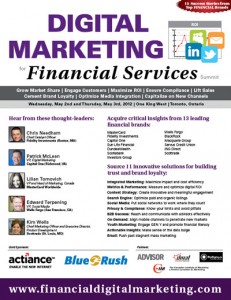
I was recently a speaker at the Digital Marketing for Financial Services conference. I gave a one hour presentation on “Effective Social Media in a Regulated Environment.”

The presentation went very well. I also had the chance to connect with some very smart people in the field.

The amazing folks at Advisor.ca wrote a great article about the conference, with several references to the presentation I gave. If you get a chance, give it a read.

Categories: Press, social-media, Strategy

Digital Sharecropping

May 15th, 2012 Comments off

j12EG-928AJeff Atwood writes a great article on Digital Sharecropping. That’s the concept that built many of the Social Networking sites such as Facebook, MySpace, Twitter and Flickr. Those sites just provide the foundation, but the content on the sites is provided by the users. The reason the users provide all of the content is…

Well, that’s a good question. Why do the users provide free content (and essentially, labour) someone else’s site? Generally a site that makes a profit off that content? Why would they so often be willing to give up their intellectual rights to that content?

That’s something to keep in mind when formulating your plan. If your Digital Strategy includes building a community around your brand, you have to ask yourself very early on, why would someone want to take the time to be part of this community and provide free content. What am I going to give them in return?

It has to be a two-way street. There has to be an added value or benefit for your community to be part of your community. Or as Jeff put it so well, the user will ask themselves, “What do I get out of the time and effort you’ve invested in this website? Personally? Professionally? Tangibly? Intangibly?”

If you don’t have a good answer to that question, you might want to take a closer look at the rest of your Digital Strategy.

Categories: Strategy

What success looks like

May 6th, 2012 Comments off

My current favourite image. This napkin sketch was tweeted by Babs Rangaiah of Unilever (@babs26). It has been attributed to Demetri Martin, the author of a book called This Is A Book.

Categories: Strategy

There’s Always a Better Way

April 22nd, 2012 1 comment

troll-webI was out with a friend the other day and I was reminded of a “creative” solution we implemented to an age-old problem. We had set up an online community for a client, and as is too common in communities, there were a couple of users that trolled the community annoying the remaining 99%.

We tried all of the usual methods to resolve it. Sending warnings to the offenders, manually editing and filtering, and finally banning the offenders. Of course, with the ease of getting a new email address and re-registering, the trolls kept coming back and it turned into a kind of “whack-a-mole” game.

Finally, I took a page from Philip Greenspun (author of the classic “Philip and Alex’s Guide to Web Publishing“) and got creative with the situation. Instead of trying to ban the users, we decided to just frustrate them into leaving on their own accord… without them knowing.

When a troll was identified, they were flagged in our database and we flagged the account. The next time the user logged in, they had a 1 in 3 chance of actually being able to log in, or getting a “Server Timeout” error message. If they did actually manage to log in, every page refresh had a random delay of 5-30 seconds, and even then, they would occasionally get a timeout message. The flagged users generally just got frustrated with the “poor quality” of our site and moved on.

One of our developers actually took it a step further. Trolls live for stirring the pot. They post abusive and over-the-top posts and wait for the firestorm. What if the firestorm never arrived and the other users just ignored their posts? The developer set the database so that when a flagged user posted a message, he would see his post in the thread, but no other users would see it. He would sit back and wait for his comments to start a flame war, but the other users would just carry on with their own discussions, unaware of the flame-bait posted.

The number of trolls dropped dramatically. Users were thrilled that their conversations continued without disruption and there were no more warnings issued by the moderators. And, of course, no one was aware of what was going on behind the scenes to clean out the disruptors.

It just goes to show… the tried and true methods sometimes don’t work. Looking for a creative solution based on the habits and motivations of your users often yields far better results than going with the textbook approach.

Categories: Strategy

Novices vs. Experts

December 6th, 2011 Comments off

I’ve been doing digital strategy for a long time now (over 15 years!). I seem to have found a pretty good niche recently, specializing in digital strategy for the Canadian financial services industry. I’ve been doing this long enough now that I feel confident to call myself an expert. However, it wasn’t until recently that I got an inkling of what it means to be an expert in a particular field.

Then I stumbled across this excellent post from Eric Barker at Barking Up The Wrong Tree. The line that tweaked with me was:

…novices sought and responded to positive feedback, and experts sought and responded to negative feedback…

Now, don’t get me wrong. I have an ego as big as the next person’s (well… maybe a little bigger). I still like it when I’ve been told that something I’ve done has been helpful / useful / profitable . However, I get more juice from someone teaching me something or guiding my thinking into a direction I haven’t been. I’d like to say I like getting pulled out of my comfort zone, but like most people I get that little feeling in my stomach that resists the move initially. But I’ve gotten to where I am because I’ve been able to take the chance to do something I’ve never done before and figure out how to do it.

Of course, it reminds me of a post I saw recently on Joey deVilla’s Accordion Guy blog:

Categories: Basics, Management, Strategy

The 4 digtal laws

November 18th, 2011 Comments off

I recently read a great post by amazing folks at Digital Tonto talking about the 3 fundamental laws of digital technology and a 4th that has nothing to do with technology. The laws are:

1. Kryder’s law which states that storage capacity doubles every year

2. Moore’s law which states that processor speed doubles every 18-24 months

3. Nielsen’s law which states that bandwidth will double every 2 years (in practice, longer)

The fourth law is what they call the Caveman Law. This article doesn’t have a great explanation of it, but in my opinion, it states that no matter how big or powerful the technology is, if it can’t fullfil a person’s primitive desires, it’s useless.

The article goes on to eulogize Steve Jobs, but this is one of the few I agree with. Apple rarely talks about the first three laws. When they launch a product, you don’t often see specs on processor speed or storage. It’s all about how it fulfills your desires. Apple did a lot of things right, but this is probably the most important.

Categories: Strategy

Simplicity

November 5th, 2011 Comments off

At my day job, one of the questions I get asked quite often is “How do I get my site to the front page of Google?” I usually have the same answer and it’s not one that everyone likes to hear.

“Write great content… regularly and consistently”

For the most part, it really is that ‘simple’. SEO techniques will only get you so far if you don’t have good, current content.

… Which is why when I came across this Salt and Pepper post from Chris Brogan, it really struck a chord with me:

Executing cleanly on simple efforts is far more valuable than pulling off something clever that gets you attention briefly, but has no lasting change.

Much of what I do is actually quite simple. It just stems from years of experience and learning from my (many, many) mistakes. What separates the wheat from the chaff in my line of work is this: The good ones can take something that looks complex and turn it into a series of simple steps. Or as Chris puts it:

And truly, if you want to know just one more secret, I’ll share it: complex is usually just a lot of simple things played out in a smart sequence.


Categories: Strategy

Social media in 2011

October 30th, 2011 1 comment

Steven van Belleghem has posted a great presentation on Slideshare showing the state of social media worldwide in 2011. Warning up front that this slideshow is well over 160 slides!

There are a few stats in this that surprised me (both positively and negatively). For example:
  • The awareness of Facebook is close to 100%
  • Facebook is used by over 400,000,000 people daily (almost half of all accounts!) with the average session lasting 37 minutes
  • Positive experiences lead to more social posts than negative experiences. I would have thought the opposite, but sadly, when I think about it, positive experiences are more unique and post-worthy than negative experiences.
  • People have on average 25 apps on their smartphones, but use only 12 apps regularly (I know that’s the case with me… I have close to 100, but most are never or rarely used)


Categories: social-media

Creating a Digital Strategy (repost)

July 4th, 2011 6 comments

I’ve been asked several times how to create a Digital Strategy from scratch. I always point people to my digital strategy blog, but I’ve been getting the feedback that the original post is hard to find as it was written a while ago and has fallen off the main page.

As I’m on vacation this week, I thought it would be a good idea to repost the original article in it’s entirety here so that it comes back to the top of the list.

Enjoy.

__________________________

The most difficult part of formulating your Digital Strategy is staring at that blank screen and blinking cursor, trying to figure out where to start. What helps is starting with a “Cheat Sheet.” The basics that need to be flushed out before you can even call it a Digital Strategy. I’ve put together several Digital Strategies for various different brands. Through lots of trial and error, Google searches, and standing on the shoulders of giants, I’ve finally put together a basic template I use when I start. It consists of six headings with the questions I have to have answered before I can even claim to have a basic strategy.

OBJECTIVE:
When this Digital Strategy is completed and executed successfully, what will be the outcome? What are you trying to achieve? Increased brand awareness? A 5% reduction in calls to the call centre? A 2% increase in sales in your North East market? Or as simple as getting 10,000 followers on Twitter? Perhaps it’s a better connection with your audience by answering 100 questions per month via online channels? You have to know why you are putting together the strategy and how you will know if you’ve executed is successfully.

Another part of the objectives is the constraints. As much as we’d all love to hear, “Take as much time and money you need to reach the objectives,” chances are you have constraints. This is where you also lay out the timelines and budget as you understand them, as well as any assumptions you are making in the rest of the strategy

AUDIENCE FOOTPRINT:
Who is your audience? What are their demographics? Are they even digital people? If so, where do they congregate? Are they primarily email users only? Do they read blogs, or do they only read “real” news sites like CNN or New York Times? Are they actively engaged in social media sites? Are they Facebook / Twitter users? Would they actually subscribe to Fan Pages? You have to have a very good idea of where your audience is, how they interact in the digital world, and what they would find relevant and engaging.

AUDIT:
OK, so now you know where your audience is and what you want to achieve. Where are you starting? Start with an audit of the digital assets you already have on hand. Domain names, logos, videos, websites (active and old “cobweb-sites”), social media profiles, etc. What are your building blocks?

Next phase of the audit is to understand how your brand is already perceived and being talked about in the digital world. Start with Google searches on your brand names, your product or service sphere and your competitors’. Set up Google Alerts to notify you when you are mentioned. Look at your existing web properties and analyse the incoming links. Where are your visitors coming from? Monitor your search engine logs to see what they’re looking for. Consider using a free or paid social media monitoring tool to dig even deeper. I’ve used Trendrr and YackTrack on the free side with varying degrees of success, though your mileage may vary. On the paid side, you could look at VoxTrot, BuzzMetrics or Cymfony.

Now is also a great time to do a competitive audit. What are you competitors doing? What’s working for them? What sort of commitment are they putting into their Digital Strategy? Do all of the above for your competitors and gauge where you stack up in your market.

ROADMAP:
The $1,000,000 question. Now that you know what you hope to acheive, what’s already out there, what assets you have on hand, and what your audience wants, what are you going to do? In your audit, you may have found some low hanging fruit. Quick executions to start building some momentum with low cost and quick wins to put the wind in everyone’s sails.

First, look at your existing websites. Are they relevant? Do they even provide the basics? Do they speak to your targetted audience? Or to your shareholders? Or to new recruits? Maybe you want to look at a complete overhaul in one fell swoop, but often time, the existing brand sites may benefit from a phased execution. Do you need special sites  targetted to special segments of your audience or specific campaigns (also know as micro-sites). Is the content on your sites current? Are they optimized for Search Engines?

Second, look at your audience profile to help determine if and how you want to engage your audience. Does the CEO need a blog? Or the heads of various business or product units? What information will you share? Who will write the blogs? Your PR or Marketing group? Or the person in charge? What Legal sign-offs are required? How often will the blogs be updated? Do you need a support forum? Do you have Frequently Asked Questions that could be found in an FAQ on your site? What about connecting via Social Media platforms? Is your audience active there? Do you want to have one (or many) Twitter accounts? What about front-line employees? How engaged do you want them to be in your connections with your audience? These are just a few of the questions that come from the audience profile.

Third, look outside your own assets. Should you be getting engaged on other sites? Sites that specialize in your product or service area. Will you monitor the forums and respond to questions about topics about your product or brand? Will you comment on other blogs about topics in your area? In short, how engaged will you be in the so-called blogosphere?

And the final question… what can you accomplish in the time and budget you have, and what part of the roadmap is for future consideration for the elusive Phase II.

(I will write further about the execution of the strategy when I post about 2MCE)

COMMITMENT:
Wouldn’t it be nice if you put together a plan, executed it, and then were done? Sadly, it’s just the beginning. The Digital Strategy needs to outline what the ongoing commitment to the strategy will entail. If you are relaunching your main sites, who’s responsible for making sure that content is fresh, updated and relevant? Who’s responsible for answering email queries about products and services? Who is responsible for monitoring the web and tracking mentions of your company, your brand and your key people? What will they do with that information? Who will be monitoring the blogs for mentions of your sphere and be able to answer questions, complaint and concerns in the comments in a professional manner? Who will monitor your own Social Media properties and put a human, social “face” behind your brand? This is an on-going operational cost, not a project cost. If you can’t get a commitment on the commitment, it’s time to rethink your Digital Strategy.

MEASUREMENT:
How will you know if you succeded? There is a post coming soon about how to measure ROI on the web, but suffice for now to say that it’s not easy to find quanititive measures. What are your measures of success? Is it site visitors? Press mentions? Blog mentions? Followers on Twitter? Fans on your Facebook page? Or something more subtle such as level of engagement by your evangelistic base? Blog mentions vs. your baseline? Google PageRank? Revenue in the North East territory? Call volumes? Go back to your Objectives and bring it full circle by showing how what you measure will prove (or disprove) your success against your objectives.

There you have it. The 6 basic pillars of a Digital Strategy. Of course, you could have more (lots more), and in the coming weeks and months, I’ll elaborate on the Digital Strategy and discuss other pillars to a strong Strategy. But if you think through these basics, you’ll be well on your way to online success!

Categories: Strategy

Reasons stop mattering

June 18th, 2011 1 comment

I’m proud to say that I worked my way through the ranks to get to the position I’m in today (VP, Digital). I started as a junior programmer for McGill Multimedia back when there was no such thing as .com (or more accurately, almost nobody had heard of it).

A long time ago, I made the transition from individual contributor to manager. That transition was difficult. I was no longer responsible for just my own work, but for the work of several others. I learned a lot of lessons the hard way. As I reacquaint myself with people that used to report to me or that I used to report to, I always feel like I should apologize for some of the things I said or did while I was learning to be a manager.

One of the key lessons I learned as I worked my way up the managerial ranks was that excuses don’t exist. I’m given goals to achieve and my job is to achieve them. If they are not achieved, I cannot go back and say that “X didn’t do what he was supposed to do.” There is no X… it’s just me and I hold all accountability for anyone that didn’t deliver on my initiative.

When I ran across this article from Business Insider about Steve Jobs and the speech he gives to new managers, it struck a chord. I wish someone had given me this speech several years ago. It would have saved me from stepping on a lot of land mines and driving my bosses crazy as I figured out the lesson above.

Excerpt:

Jobs tells the VP that if the garbage in his office is not being emptied regularly for some reason, he would ask the janitor what the problem is. The janitor could reasonably respond by saying, “Well, the lock on the door was changed, and I couldn’t get a key.”

An irritation for Jobs, for an understandable excuse for why the janitor couldn’t do his job. As a janitor, he’s allowed to have excuses.

“When you’re the janitor, reasons matter,” Jobs tells newly minted VPs, according to Lashinsky.

“Somewhere between the janitor and the CEO, reasons stop mattering,” says Jobs, adding, that Rubicon is “crossed when you become a VP.”

Remember that as you climb the ranks, at a certain level there are no more excuses. Only success or failure.

Categories: Management

IETV Interview

March 16th, 2011 Comments off

After my interview with Investment Executive, they invited me in to an on-camera interview about social media and the new guidelines for investment advisors.

Click on the image below to go to the video interview:

Categories: social-media

Investment Executive article

March 12th, 2011 Comments off

Forgive a little ego stroking, but I was recently featured on the front page of Investment Executive magazine. I gave an interview regarding the social media efforts at the company I work for.

Click on the image to read the article

Categories: social-media

Managing vs. Running a project

December 6th, 2010 Comments off

I keep an online notebook with quotes and articles I want to hang on to (thank you Evernote!)

I’m usually pretty good with keeping the source, but in this case I lost it. However, the quote is so insightful that I wanted to post about it anyway.

If you choose to manage a project, it’s pretty safe. As the manager, you report. You report on what’s happening, you chronicle the results, you are the middleman.

If you choose to run a project, on the other hand, you’re on the hook. It’s an active engagement, bending the status quo to your will, ensuring that you ship.

Running a project requires a level of commitment that’s absent from someone who is managing one.

We’ve all worked with ‘project managers,’ but very few of us have had the pleasure to work with ‘project runners.’ I like to consider myself a runner. If I’m responsible for delivering, I own it all and find every avenue to ensure the project delivers.

Which one are you?

P.S. If this is your quote, or you know where it came from, please ping me and I’ll make sure to give you the proper attribution.

Categories: Management